The aerospace industry relies heavily on key vendors who supply advanced components, systems, and services essential for aircraft manufacturing, maintenance, and operations. These vendors are industry leaders known for their innovation, quality, and comprehensive support in various aerospace sectors. Below, we introduce some of the most influential aerospace vendors making a significant impact worldwide:
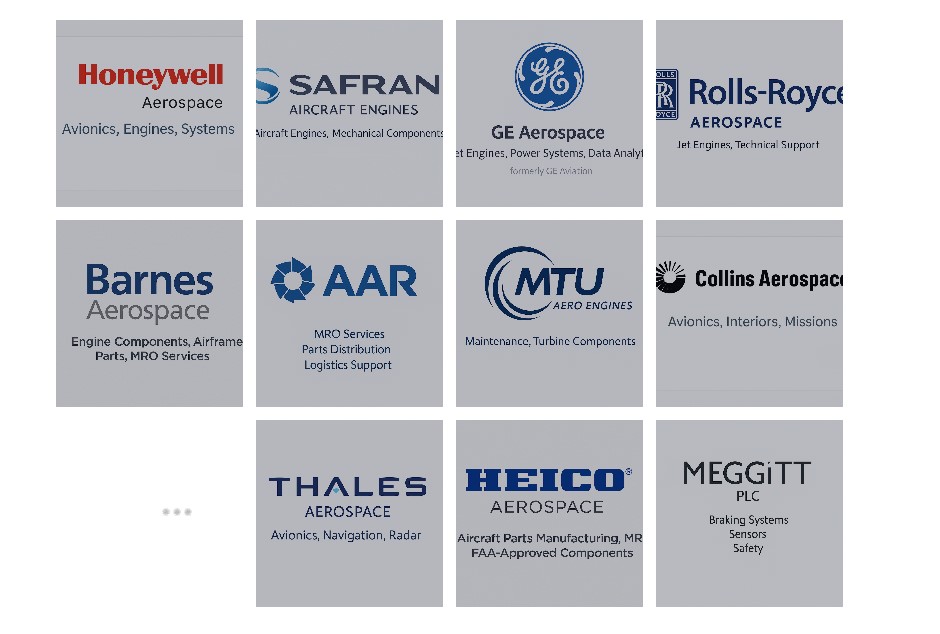
Honeywell Aerospace
Honeywell Aerospace is renowned for its cutting-edge such as avionics, engines, and integrated systems. Their technologies enhance aircraft performance, safety, and efficiency, making Honeywell a vital supplier for commercial and military aviation.

History and Foundation
Honeywell’s roots go back to 1906, when it was founded as the Minneapolis Heat Regulator Company. The company adopted the Honeywell name in 1927 and steadily expanded into aerospace through major mergers, most notably with AlliedSignal in 1999. Over the decades, Honeywell Aerospace has become a world leader in aircraft systems, leveraging its expertise to improve performance, safety, and operational efficiency in both civil and military aviation.
Products and Capabilities
Honeywell manufactures advanced avionics systems, including flight management computers, cockpit displays, and navigation/communication equipment. It is a leading producer of Auxiliary Power Units (APUs), which provide electrical and pneumatic power to aircraft when engines are not running. The company also delivers wheels and brakes, environmental control systems, and flight control systems—all engineered to enhance safety, fuel efficiency, and passenger comfort.
Safran Aircraft Engines
Specializing in aircraft engines and mechanical components, Safran is a global leader in propulsion systems. Their expertise in engine manufacturing and maintenance ensures reliable and efficient power for various aircraft models.
History and Foundation
Safran was created in 2005 through the merger of SNECMA and SAGEM, but its aerospace engine heritage stretches back to the 1940s. SNECMA, a key French propulsion manufacturer, played a major role in jet engine development during and after World War II. Today, Safran Aircraft Engines is a global leader in propulsion technology, known for designing, manufacturing, and maintaining high-performance jet engines.
Products and Capabilities
Safran is best known for its turbofan engines—including the legendary CFM56 and next-generation LEAP engines—developed in partnership with GE Aerospace through the CFM International joint venture. The company also produces nacelles, engine control systems, and various mechanical components. Beyond manufacturing, Safran provides comprehensive MRO (Maintenance, Repair, and Overhaul) services for both commercial and military aircraft engines.
GE Aerospace
Formerly known as GE Aviation, GE Aerospace offers jet engines, power systems, and data analytics solutions. Their advanced engineering supports fuel efficiency and environmental sustainability in the aerospace sector.

History and Foundation
First and foremost, GE Aerospace—formerly known as GE Aviation—has a legacy that traces back over a century. Its parent company, General Electric, was founded in 1892, but GE’s entry into aviation began in the early 20th century when it developed the first U.S. jet engine during World War II. Over time, the division became a powerhouse in the aerospace sector, driving innovation in engine technology, digital systems, and propulsion efficiency. In 2023, the business officially rebranded to GE Aerospace, reflecting its specialized focus on aviation.
Products and Capabilities
In terms of products, GE Aerospace is best known for its jet and turbofan engines, which power everything from single-aisle commercial jets to massive long-haul aircraft. Notable examples include the GE90, GEnx, and CF6 engines, as well as the LEAP engines developed in partnership with Safran through CFM International. Furthermore, GE is pioneering next-generation propulsion technologies aimed at reducing fuel burn and emissions, including open-fan designs and hybrid electric concepts.
Beyond engines, GE Aerospace also offers digital solutions—such as engine health monitoring and predictive analytics—that allow airlines to improve performance and reduce downtime. Coupled with comprehensive MRO services, GE ensures that its engines maintain peak efficiency throughout their operational life. As a result, GE Aerospace remains a driving force in shaping the future of aviation technology.
Rolls-Royce Aerospace
Rolls-Royce is a trusted name in jet engine manufacturing and technical support. Their engines power many of the world’s commercial and military aircraft, delivering exceptional performance and reliability.
History and Foundation
Meanwhile, Rolls-Royce Aerospace has an equally distinguished heritage. The company was originally founded in 1906 in Manchester, England, by Charles Rolls and Henry Royce, initially as a manufacturer of luxury automobiles. However, during World War I, Rolls-Royce began producing aircraft engines—a move that ultimately became its defining business. Over the decades, it evolved into a global leader in aerospace propulsion, with a focus on high-performance engines for both civil and defense applications.
Products and Capabilities
Rolls-Royce is perhaps best recognized for its large turbofan engines used in wide-body commercial jets, such as the Trent 1000, Trent XWB, and Trent 7000 families. These engines are celebrated for their advanced aerodynamics, fuel efficiency, and durability. In addition, the company develops military engines like the EJ200 (used in the Eurofighter Typhoon) and the AE 2100 turboprop.
Furthermore, Rolls-Royce invests heavily in sustainable aviation technologies, including ultra-efficient gas turbines and hybrid-electric propulsion systems. It also operates an extensive global MRO network, ensuring that its engines receive expert maintenance and support throughout their life cycles. Thanks to its blend of heritage, innovation, and engineering excellence, Rolls-Royce Aerospace continues to be one of the most respected names in the industry.
Barnes Aerospace
Barnes Aerospace provides engine components, airframe parts, and MRO (Maintenance, Repair, and Overhaul) services. Their comprehensive solutions support aircraft lifecycle management and operational readiness.

History and Foundation
To begin with, Barnes Aerospace is a division of Barnes Group Inc., a company whose origins date back to 1857 in Bristol, Connecticut, USA. While the parent company initially focused on manufacturing components for the clock industry, it gradually diversified into precision manufacturing for multiple sectors. Barnes Aerospace itself emerged as a specialized division dedicated to the aerospace industry, developing a reputation for high-precision components and world-class maintenance services. Over the years, it has grown to serve both commercial and military aviation markets around the globe.
Products and Capabilities
When it comes to offerings, Barnes Aerospace manufactures critical engine components, including cases, rings, seals, and complex fabricated assemblies used in gas turbine engines. These components are essential to both original equipment manufacturers (OEMs) and aftermarket operations. In addition to manufacturing, the company operates Maintenance, Repair, and Overhaul (MRO) facilities that service turbine engines and assemblies, ensuring they perform at optimal levels.
Furthermore, Barnes Aerospace places strong emphasis on advanced materials and manufacturing techniques, such as high-temperature alloys, precision machining, and complex fabrication processes. This allows the company to meet the rigorous standards of modern aerospace engineering. As a result, it has become a trusted partner for major engine manufacturers, helping them achieve improved performance, fuel efficiency, and reliability in their products.
AAR
AAR is a key player in MRO services, parts distribution, and logistics support. They offer tailored solutions to keep fleets operational and minimize downtime for commercial and defense customers.

History and Foundation
To start, AAR Corp. was founded in 1955 in Chicago, Illinois, by Ira A. Eichner. Initially, the company operated under the name Allen Aircraft Radio and focused on supplying aircraft radio and electronic components. However, as the aviation industry evolved, AAR steadily broadened its scope. By the late 20th century, it had transformed into a comprehensive aerospace services provider. Today, AAR stands as one of the leading independent providers of aviation services worldwide, serving commercial airlines, government agencies, and defense contractors alike.
Products and Capabilities
When it comes to capabilities, AAR offers a diverse portfolio that spans multiple aspects of aviation support. For instance, its Maintenance, Repair, and Overhaul (MRO) services are delivered through strategically located facilities, ensuring quick turnaround times for customers. In addition, the company specializes in parts supply and distribution, offering a vast inventory of OEM and FAA-approved aftermarket components. Furthermore, AAR provides engineering services, logistics solutions, and aircraft modification programs, which help operators extend fleet life and improve operational readiness.
Moreover, AAR is known for its flexibility and ability to tailor solutions for both civilian and military clients. This adaptability, combined with its strong global supply chain, has allowed AAR to maintain a competitive edge in an industry where efficiency, safety, and reliability are critical. As a result, it continues to be a trusted partner for organizations looking to optimize aircraft performance while controlling costs.
MTU Aero Engines
MTU Aero Engines focuses on maintenance and turbine components. Their expertise in engine repair and overhaul helps maximize aircraft availability and extend engine lifespan.

History and Foundation
Similarly, MTU Aero Engines has a long and distinguished history. Established in 1969 in Germany as Motoren- und Turbinen-Union, the company became MTU Aero Engines AG in 2000, marking the start of its independent operations. Since then, MTU has positioned itself as a trusted partner to many of the world’s leading engine manufacturers, including Pratt & Whitney, GE, and Rolls-Royce. This collaborative approach has helped MTU expand its expertise and market presence significantly.
Products and Capabilities
From a technical standpoint, MTU specializes in high-precision turbine and compressor components for advanced turbofan engines. In addition to manufacturing, MTU is heavily involved in the MRO sector, offering complete engine overhauls, component replacement, and performance optimization programs. As a result, airlines and defense operators alike depend on MTU to extend engine lifespans, improve fuel efficiency, and reduce overall operational costs. Furthermore, MTU’s continuous investment in innovation ensures that its solutions remain at the cutting edge of aerospace technology.
Collins Aerospace
Known for avionics, interiors, and mission systems, Collins Aerospace delivers integrated solutions that enhance aircraft functionality and passenger experience.

History and Foundation
To start, Collins Aerospace was formed in 2018 through the merger of UTC Aerospace Systems and Rockwell Collins, following the acquisition of Rockwell Collins by United Technologies Corporation (UTC). This strategic union combined decades of expertise in avionics, aircraft interiors, and integrated systems. Later, in 2020, Collins Aerospace became part of Raytheon Technologies Corporation after the historic merger between Raytheon and UTC. Thanks to this heritage, the company draws on a rich legacy of engineering innovation, dating back to the early 20th century, when Rockwell Collins pioneered aviation communications and UTC developed advanced aerospace components.
Products and Capabilities
Collins Aerospace offers one of the broadest portfolios in the aerospace industry, covering nearly every system an aircraft requires. In avionics, the company designs flight management systems, cockpit displays, and navigation/communication equipment that enhance pilot awareness and operational safety. Furthermore, its interiors division delivers advanced seating, lighting, and cabin systems aimed at improving passenger comfort.
In addition, Collins Aerospace provides landing gear systems, actuation systems, and ice protection technologies, ensuring aircraft operate safely in all conditions. It also plays a significant role in military and space programs, offering mission systems, helmet-mounted displays, and environmental control systems for defense applications. Moreover, through continuous innovation in connectivity solutions—including high-speed in-flight internet—the company helps airlines deliver a modern, connected passenger experience.
By integrating multiple systems under one roof, Collins Aerospace enables aircraft manufacturers and operators to streamline supply chains, reduce maintenance complexity, and boost overall performance, making it an indispensable partner across the aviation sector.
Thales Aerospace
Thales Aerospace specializes in avionics, navigation, and radar technologies. Their systems improve situational awareness and safety for both commercial and military aviation.

History and Background
Thales Aerospace, a division of Thales Group, is a world-class leader in avionics, flight systems, and aircraft electronics. The parent company, founded in 1893 in France, has over a century of innovation in high-technology industries. In 2000, it rebranded to Thales, expanding its reach into civil aviation, defense, and space. Today, Thales Aerospace is recognized globally for delivering cutting-edge solutions that enhance flight safety, operational efficiency, and passenger experience for both commercial and military aircraft.
Products and Capabilities
Thales Aerospace offers a comprehensive range of avionics products, including flight management systems (FMS), cockpit displays, and advanced navigation equipment. These systems are designed to improve pilot situational awareness, navigation accuracy, and fuel efficiency. Additionally, the company produces radar and surveillance systems for both civilian air traffic management and military operations, ensuring reliable performance in demanding environments.
Beyond avionics, Thales is a leading provider of in-flight entertainment and connectivity (IFEC) solutions, enabling airlines to offer passengers high-speed internet and personalized onboard content. In the defense sector, Thales Aerospace designs mission systems, secure communication platforms, and electronic warfare technologies, supporting tactical readiness and operational success.
HEICO Aerospace
HEICO Aerospace manufactures aircraft parts and offers MRO services with FAA-approved components. Their products meet high safety standards and support a wide range of aircraft models.

History and Background
HEICO Aerospace, part of HEICO Corporation, has grown into one of the largest independent providers of FAA-approved aircraft replacement parts and aviation maintenance services. Founded in 1957 and headquartered in Hollywood, Florida, HEICO has built a strong reputation for cost-effective, high-quality aerospace solutions. Over the decades, the company has expanded through strategic acquisitions, serving commercial airlines, defense operators, and OEMs around the world.
Products and Capabilities
HEICO Aerospace specializes in manufacturing FAA-approved aircraft parts—often referred to as PMA (Parts Manufacturer Approval) components—which offer operators a more affordable alternative to OEM parts without compromising safety or performance. Its product range includes engine components, hydraulic systems, electrical assemblies, and structural parts for a wide variety of aircraft models.
In addition, HEICO operates multiple Maintenance, Repair, and Overhaul (MRO) facilities, providing services for engines, avionics, and mechanical systems. These capabilities allow airlines and military customers to reduce downtime, extend component life, and optimize fleet efficiency. HEICO’s strong engineering team also supports custom design and manufacturing for specialized aerospace applications.
Pratt & Whitney Aerospace
Pratt & Whitney Aerospace is a leading manufacturer of aircraft engines and provides comprehensive MRO (Maintenance, Repair, and Overhaul) services. Their advanced propulsion systems are renowned for reliability, fuel efficiency, and innovation, serving a broad spectrum of commercial, military, and business aircraft.

History and Background
Founded in 1925 and headquartered in East Hartford, Connecticut, Pratt & Whitney has been a pioneer in aerospace engine technology for nearly a century. As a subsidiary of Raytheon Technologies, Pratt & Whitney has grown to become one of the world’s foremost engine manufacturers, powering thousands of aircraft globally. The company’s commitment to research and development has driven advancements in jet engine performance, environmental sustainability, and operational efficiency.
Products and Capabilities
Pratt & Whitney Aerospace designs, manufactures, and services a diverse range of aircraft engines, including the widely recognized PW1000G Geared Turbofan, F135 military engine, and the PW4000 series. Their engines power commercial airliners, regional jets, military fighters, and business jets, offering superior thrust, reduced emissions, and lower operating costs.
The company also operates extensive MRO facilities worldwide, providing overhaul, repair, and performance enhancement services for their engines and related systems. Pratt & Whitney’s engineering expertise supports innovative solutions such as additive manufacturing, predictive maintenance, and digital engine health monitoring, helping operators maximize engine life and fleet availability.
RFQ – SCREW,MACHINE